WHITEPAPER | A Fact-Based Guide to 5 Top Data Center Concerns
Friday, May 15, 2026
(0 Comments)
From power grids and water consumption to land use and economic benefits, this paper takes a data-driven look at top data center community concerns and how the industry is addressing them.
DOWNLOAD PDF
By Brian Holak
Executive Summary
As data centers evolve into an essential backbone of our digital world, their unprecedented expansion has understandably triggered a wave of public debate and policy discussions.
It’s a tremendously important, community-level conversation that’s needed to understand and manage the changes ahead. The discussions, however, are too often shaped by incomplete data and don’t always reflect the fast-changing reality and latest data
center industry best practices. Perceptions of the data center industry influence community sentiment, infrastructure planning, and policy at a moment when digital reliability, economic growth, national security, and energy transition goals are deeply
intertwined with data center development. This paper examines five of the most commonly cited community concerns regarding data centers, providing evidence-based context to clarify data centers’ real-world impacts and ongoing evolution.
- Concern #1: Data centers will overwhelm the power supply.
The surge in electricity demand is real and visible, yet there are numerous forces driving electricity demand in addition to data centers. And while data centers tap increasing
amounts of power, the demand and investment from data centers is also acting as a catalyst for improvements in power generation and transmission. Rather than only straining the system, the data center industry is becoming a primary driver of clean
energy procurement, onsite generation, increased power storage, and grid infrastructure modernization required for a digital-driven, electricity-intensive economy.
- Concern #2: Data centers risk draining local water supplies.
Water use varies by region and technology, and while the industry lacks comprehensive data, aggregate consumption is small relative to many other industrial and commercial
sectors. The industry is increasingly using non-potable sources and high-efficiency, closed-loop cooling to further shrink water use.
- Concern #3: Any open plot of land is a target for data centers.
Development is constrained by power availability, permitting timelines, and grid capacity, with many projects concentrated in established industrial areas or repurposed
“brownfield” sites.
- Concern #4: Data centers are noisy neighbors with limited local upside.
Modern data centers are quieter than previous generations, generate minimal traffic, and often deliver outsized fiscal benefits through tax revenue, infrastructure
upgrades, and long-term workforce development.
- Concern #5: AI is the only thing driving data center growth.
AI is undoubtedly the force accelerating demand, but it is building upon a decades-long foundation. Long-term expansion is also driven by cloud adoption, Internet of
Things, edge computing, and the broader digitalization of the global economy.
By moving beyond the headlines and grounding the public dialogue in current data, this paper looks to help ensure these important community concerns are addressed through the kind of productive engagement that helps both communities and the digital economy
to thrive in tandem.
Introduction
As data centers have become essential infrastructure powering the digital world, community members, policymakers, and industry stakeholders alike are asking important questions about
how the explosive growth of these facilities is affecting local infrastructure, natural resources, community well-being, and environmental sustainability. These conversations are necessary because data centers are not impact-free; they make real demands
on shared resources, and as their footprint grows, so does the collective responsibility to ensure they are thoughtfully developed. In some cases, however, those conversations are shaped by incomplete data, high-profile headlines, or nonrepresentative
anecdotes, which can obscure the nuances involved.
Perceptions about data centers can influence not only community trust but also infrastructure planning and regulatory decision-making at local, state, and federal levels. When the public
narrative is driven by polarizing debates, the nuance required to solve complex infrastructure challenges can get lost in the noise. Constructive dialogue depends on shared access to accurate, current, and contextualized information, particularly
as the industry continues to evolve and adapt.
This paper explores five of the most commonly cited concerns surrounding data centers, examining where they originate, what current data shows, and how industry practices are adapting in response.
By grounding the conversation in evidence and context, the goal is not to dismiss public concerns, but to facilitate more informed, productive engagement around the role data centers play in today’s digital and economic landscape.
Concern #1: Data Centers Will Overwhelm the Power Supply
The risk of rising electricity rates is one of the most frequently raised concerns in the industry, born from the very real pressures
of evolving digital infrastructure and broad industry demand. While it’s true that data centers consume a significant amount of electricity, and that power grids are under increased strain from a rapid rise in demand, the broader context is sometimes
missing from the conversation. The reality is that our aging energy infrastructure is facing a surge from multiple fronts, not just the data center sector. And data center developers and operators are increasingly funding grid modernizations
and leading the increased use of new clean energy generation. The Broader Context
Global electricity consumption is rising at its fastest pace in years, with demand increasing
4.3% in 2024 and projected to grow close to 4% annually through 2027 – an unprecedented 3,500 TWh increase over three years, according to the International Energy Agency (IEA). 1 The data center sector is materially contributing to this
increase, accounting for approximately 1.5% of global electricity consumption in 2024 and 4.4% of total U.S. electricity demand – with U.S. use projected to rise to 6.7%-12% by 2028. 2 That said, data centers are just one part of a larger
electrification trend. The IEA estimates data centers will account for only about one-tenth of global electricity demand growth through 2030 – less than industrial motors, air conditioning in homes and offices, or electric vehicles. 3 At
the same time, 70% of U.S. transmission lines are more than 25 years old and approaching the end of their typical 50- to 80-year lifecycle, which contributes to power outages and grid instability. 4The story isn’t just about
how much electricity data centers use, but how new demand is planned for and supplied. The data center sector is a leading force in clean energy adoption, accounting for roughly 50% of all U.S. corporate clean energy procurement in 2024. 5 Importantly, these long-term power purchase agreements (PPAs) are usually secured years in advance to finance new generation, helping expand supply. The IEA estimates renewables will meet nearly half of global data center electricity demand growth
by 2030. 6 A recent S&P report found that global data centers already source an estimated 58% of their power from renewables. 7 Hyperscalers such as Google, Microsoft, and Meta are setting the pace with ambitious 2030 net-zero
and carbon-negative commitments, while investing in emerging clean energy – including nuclear, hydrogen, enhanced geothermal, and long-duration storage – to secure stable, low-carbon power and support long-term grid reliability.
A growing number of data centers are also deploying behind-the-meter onsite power such as fuel cells, natural gas generation, and renewables with battery storage to meet demand without relying solely on public utilities. Bloom Energy projects
38% of data centers will use onsite generation for primary power by 2030, with 27% expected to be fully powered onsite. 8 This shift reduces pressure on local grids, lowers peak demand that drives up costs for other customers, and can ease
energy transmission congestion and outage risk. Where grid power is used, operators frequently fund substations, transmission upgrades, and interconnection infrastructure, and collaborate with utilities on long-term planning. In early 2026,
Amazon, Google, Meta, Microsoft, OpenAI, Oracle, and xAI signed a non-binding U.S. federal pledge to fund grid upgrades and “pay their own way” to help head off electricity rate increases for local communities. More broadly, the data center industry
has become a catalyst for some of the most consequential grid modernization efforts in the United States. One example is PJM Interconnection, the nation’s largest grid operator, which recently approved a historic $11.8 billion investment plan aimed at expanding and hardening its transmission network – driven mostly by large-scale data center demand. That concentrated, long-term load provides the economic certainty
utilities need to greenlight major “backbone” infrastructure, including projects such as Virginia’s first high-voltage, direct-current (HVDC) underground transmission line. In this way, the industry is not simply adding demand to the system; it’s
helping fund the next generation of power infrastructure that will benefit all regional customers.
Bottom Line
Data centers add demand to the grid, but they’re also actively working and uniquely positioned to help stabilize it. While they are only one component of a broader electrification
trend, data center providers fund new clean energy, leverage onsite power to reduce strain, and act as a financial catalyst for the large-scale infrastructure upgrades an aging grid needs.
Concern #2: Data Centers Risk Draining Local Water Supplies
Water use has become a lightning-rod issue in the data center debate. In an era of increasing droughts and evolving climates,
the protection of essential watersheds should be a top priority for communities and developers alike. While headlines often suggest data centers are siphoning off scarce freshwater, the data reveals a more nuanced reality. Data centers do use water,
primarily for cooling, but how much they use, how efficiently they use it, and where it comes from varies by location and technology. The adoption of new cooling methods alone is dramatically reducing water use. At the same time, growing regulatory
scrutiny and rising water costs incentivize the industry toward greater conservation. A challenge in discussing this topic is that the data itself is often incomplete; a lack of standardized reporting and up-to-date analysis makes it difficult to
see the full picture. With that said, let’s look at what we know. The Broader Context
First, we need to understand how data centers use water. Most direct water use is for cooling
systems. In the past, the largest use of water was for traditional evaporative cooling, where water absorbs heat and partially evaporates. In traditional air cooling, facilities rely on "chiller" units that use evaporation to lower the temperature
of the air before it’s circulated through the server room. This process can lose thousands of gallons of water per day to the atmosphere as steam. However, the data centers being built today largely rely on modern cooling systems that represent
a significant departure from these legacy evaporative approaches. Much of the industry is transitioning to water-efficient technologies such as closed-loop liquid cooling – including both direct-to-chip and immersion methods – as well as hybrid systems
that utilize ambient air. In closed-loop designs, water is recirculated multiple times and a portion is returned to wastewater systems for treatment and reuse. This can cut water loss by an estimated 70% compared to traditional cooling. 9 Microsoft’s new chip-level liquid cooling system – deployed in 2024 and now the standard for its new AI campuses – eliminates evaporative water entirely and reportedly reduces annual water use by more than 125 million liters per facility.10 Vertiv and Compass Datacenters have been deploying a liquid-air hybrid system to accelerate their water-free pledge. So how much water are we talking about? In the U.S., all data centers combined were estimated to consume about 449 million gallons per day (1.7 billion
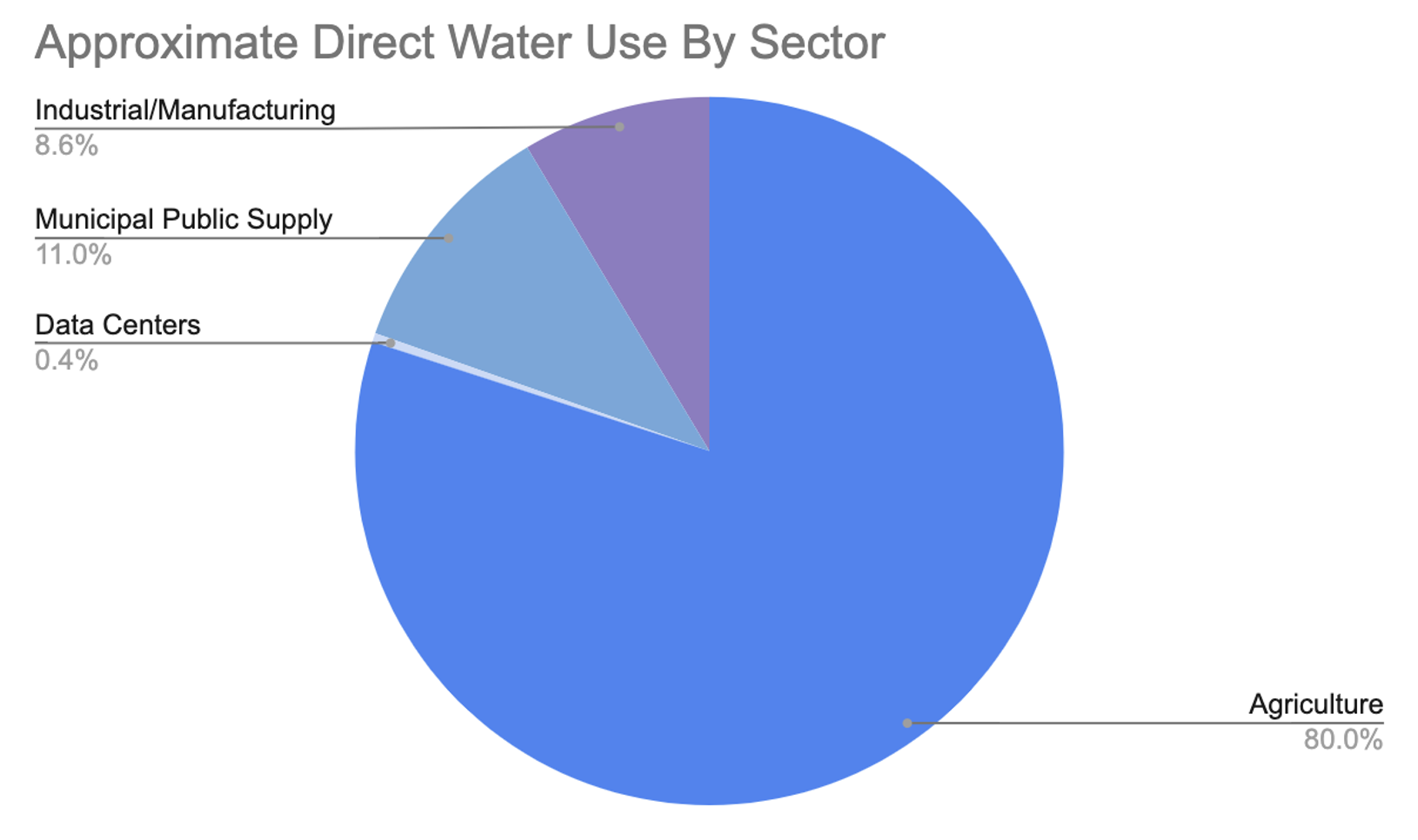
liters) as of 2021 – roughly 0.3-0.4% of total daily U.S. water withdrawals. 11 That’s meaningful, but relatively small compared to agriculture or power generation. For context, a 15 MW data center uses roughly the same amount of water as
two 18-hole golf courses. Google notes that its entire global data center fleet used about the same amount of water in 2024 as irrigating 54 golf courses annually in the U.S. Southwest. And 86% of its freshwater withdrawals came from sources at low
risk of water depletion or scarcity. 12
Note: Percentages are approximate and meant for context. Water use figures refer to direct onsite consumption only. Data sources: U.S. DOE / Lawrence Berkeley National Laboratory estimates of U.S. data center direct water consumption (2023); GCSAA water survey of U.S. golf courses (2024); USDA 2023 Irrigation & Water Management Survey; U.S. Geological Survey public supply and water use data.
Concerns tend to intensify when potable water is involved. Back in 2021, one analysis found that 57% of direct data center water use came from drinking-quality water sources.13 But that’s changing. Google now uses reclaimed or non-potable water
at over 25% of its campuses, while Equinix reported 25% non-potable water use across its facilities in 2023. Twenty-four AWS data centers now cool with purified wastewater,
with the tech giant set to expand that to 120 by 2030. In addition, major players including Google, Microsoft, and AWS have committed to being “water positive” by 2030, replenishing more water than they consume. As of late 2024, AWS reported
reaching 53% of this goal.
Bottom Line:
Water use is a real issue, but claims that
data centers are draining local supplies often overlook regional nuance, the shift toward non-potable sources, and a sector that is actively engineering its way toward far lower water footprints.
Concern #3: Any Open Plot of Land is a Target for Data Center Development
As data center development accelerates, it can feel like no piece of land is off-limits – especially with JLL reporting
that 64% of North American capacity currently under construction is located in “frontier markets.” 14 While the pace of expansion is real, and developers are moving into new communities, where data centers can actually be built is more constrained
than it may appear. In practice, data center locations are chosen within a narrow set of technical, regulatory, and economic requirements, which most often steer development toward established industrial corridors or previously developed land. The
visibility of large hyperscale campuses on previously agricultural or greenfield sites can amplify perceptions of unchecked growth, even as most capacity remains concentrated in a relatively small number of regions. The Broader Context
Power
availability is the largest factor in new data center development, not open land. Developers require reliable, high-capacity electricity, and, increasingly, access to low- or zero-carbon energy. Secondary limiting factors include fiber connectivity,
climate conditions, seismic stability, water availability, and political support. In the U.S., grid congestion and multiyear interconnection queues now dictate much of where projects can realistically move forward. Permitting and public review also check the development process. Large facilities often face years-long approval timelines,
environmental assessments, zoning reviews, and community consultations before construction begins. Construction timelines can range anywhere from two to six years, according to CBRE. 15 While hyperscale projects are moving into
secondary and tertiary markets in search of power and speed to online, demand remains notably concentrated. According to McKinsey, Tier 1 hubs like Northern Virginia, Dallas, Texas, and Santa Clara, Calif. still account for roughly 30% of U.S. data
center capacity. 16 And the IEA notes that half of the U.S. data centers currently being built are part of preexisting large clusters. 17Data center development also creates strong opportunities for industrial repurposing.
Former coal plants, brownfield industrial zones, and legacy infrastructure are increasingly being redeveloped, reducing the need for undeveloped land. 18 Recognizing
that no form of development is impact-free, data centers are typically located in industrial or commercially zoned areas, and large projects routinely undergo environmental reviews designed to identify and mitigate biodiversity impacts. 19Major players have also adopted "nature-positive" mandates to offset their physical presence. Microsoft, for example, has already fulfilled a pledge to protect more land than it uses,
with over 15,849 acres of mature ecosystems permanently protected as of 2025 – a conservation footprint that significantly exceeds its actual building acreage. Bottom Line
Data
centers are multiplying and moving into new markets, but where they end up is shaped less by an empty plot of land than by power, policy, and connectivity. By prioritizing the reuse of industrial brownfields and investing in large-scale land conservation,
the industry is working to balance its physical growth with the protection of the environment and local communities. Concern #4: Data Centers Are Noisy Neighbors with Limited Local Upside
Headlines regarding noise, aesthetics, and limited community benefits fuel local anxiety around data center development. Living near a large-scale industrial facility can bring a significant change for a community, and the burden of proof rests on developers
to show they can be a net positive. To address community concerns, data center development increasingly follows a community partnership model that prioritizes long-term coexistence through shared infrastructure and economic goals. Today’s facilities
are also engineered to be better neighbors proactively mitigating noise, light, and visual disruptions. Beyond that, they generate skilled jobs during construction and operation. The argument of limited financial benefit often misses how deeply integrated
and fiscally beneficial these facilities are becoming with the places they call home. The Broader Context
Noise and aesthetic concerns are legitimate, but modern facilities are
engineered from the start to be quieter, unobtrusive neighbors. For example, to meet local ordinances, mechanical equipment is now typically housed indoors or within acoustically treated enclosures, utilizing advanced low-noise cooling technologies. 20 Unlike
factories or warehouses, operational data centers also generate minimal traffic, eliminating the noise and congestion associated with bustling truck loading docks. To keep facilities from being an eyesore, operators increasingly use creative architecture
such as varied façades and dense landscaping to help them blend into their surroundings. 21 While exceptions exist, and older facilities didn’t always prioritize these impacts, today’s data centers are designed and operated with careful
attention to their surrounding communities. It’s also easy to underestimate the economic footprint of a data center by focusing only on permanent staffing. A PwC report commissioned by the Data Center Coalition finds the data center industry’s
national employment impact, counting direct, indirect, and induced effects from data center construction and operations, increased from 2.9 million jobs in 2017 to 4.7 million jobs in 2023, a 60% rise that outpaced overall U.S. economic growth.
22 The industry’s contribution to national labor income rose 93% in that time, from $209 billion to $404 billion, the report found. Construction phases are labor-intensive and can stretch over multiple years. At Oracle’s Abilene, Texas
site, for example, more than 8,000 construction workers have supported the project since work began in 2024, the company says. 23 Part
of the site is operational and construction continues on other segments. For new campuses in Wisconsin and New Mexico, Oracle expects about 4,000 construction jobs at each site. A separate PwC study found that for every direct data center job created,
six additional indirect or induced jobs are supported across the regional economy. 24The fiscal impact on local governments can be even more meaningful, which is why many U.S. states offer incentives to attract new data centers.
In Loudoun County, Virginia – the world’s largest data center market – data centers generate 38% of the county’s General Fund revenue and nearly half of its property tax base, while paying roughly $26 in taxes for every $1 of public services they
consume.
25 In Arizona, data centers contributed more than $863 million in state and local taxes in 2023. 26Lastly, site selections and approvals have evolved into a collaborative process where early community engagement is
now a prerequisite for long-term project viability. These partnerships often result in legally binding community benefit agreements (CBAs) to upgrade public infrastructure such as roads, power grids, and water systems, as well as fund sustainability
initiatives or new community spaces. 27 By partnering with local colleges to upskill workers and investing in STEM education and grants, these facilities can create a "cluster effect" that attracts investment and high-tech talent, as seen
in hubs across Ohio and Virginia. 28Bottom Line
Data centers are not impact-free, but the claim that they are bad neighbors with little local upside overlooks their
proven economic benefits. When thoughtfully sited and responsibly developed, they are stable and fiscally beneficial and can be designed to fit into the community, working in partnership with the communities they join.
Concern #5: AI Is the Only Thing Driving Data Center Growth
It’s easy to see why generative AI dominates the conversation around data center growth; AI’s rise has been meteoric. Research from
the Federal Reserve Bank of St. Louis and Harvard University suggests that generative AI is being adopted faster than almost any previous technology, including the personal computer and the internet. By late 2025, overall usage – spanning both professional
and personal tasks – reached 54.6% of the U.S. working-age population.29
However, while training and running AI is undoubtedly a significant and resource-intensive use of data center capacity and
power, it represents one piece of a broader digital infrastructure picture. Since most facilities handle a blend of various workloads, determining the exact percentage of load demand tied strictly to AI is difficult. As a result, analysts typically
rely on modeled estimates rather than precise reporting.30 When we look closer, it becomes clear that data center growth is also driven by a broad, collective transition toward the digital-supported society that we all participate in every
day.
The Broader Context
While the "AI-only" narrative is understandably prominent, it’s helpful to view it alongside the massive surge in global data volume and digital activity that
has been building for years. In 2025 alone, we generated an estimated 181 zettabytes of data globally – a staggering 150% increase from just two years ago.31 To put that in perspective, a single zettabyte is enough storage for 30 billion
4K movies.32 And while AI requires more intensive compute power than traditional applications, JLL estimates that AI represented about 25% of data center workloads in 2025.33 AI could represent half of all workloads by 2030,
JLL estimates, as running AI models becomes the primary driver instead of training them. Today the majority of data center demand continues to come from the steady, large-scale shift to cloud computing and software as a service as companies move away
from on-premises infrastructure.34 According to Forrester, more than 60% of all enterprise data is now in the cloud as of 2025, and that number is expected to increase.35
At the same time, the rise of 5G-enabled edge
computing and the Internet of Things (IoT) is also accelerating the need for greater – and more localized – data center capacity.36 Because IoT and similar edge computing applications require real-time responsiveness to work effectively,
data must be handled closer to where we actually live and work to avoid latency. This is especially important for supporting smart city infrastructure, industrial automation, and the estimated 75 billion IoT devices expected by 2030.37
Beyond enterprise shifts, our personal digital habits also are quietly expanding baseline data center traffic. The average U.S. household now has 21 connected devices, including speakers, lights, TVs, and streaming devices.38 And
with 7.4 billion smartphones in use and more than 6 billion people online globally, that footprint is only getting bigger. 39 Supporting this requires efficient, reliable data center facilities to handle
real-time interactivity and synchronization at a scale far beyond simple web browsing.
Bottom Line
AI is undoubtedly accelerating data center demand and changing the way the industry
designs facilities, but it’s building upon a foundation of digital services demand that has been growing for decades. Ultimately, our need for this expansive digital infrastructure is woven into almost every facet of modern life.
The Path Forward: Why Getting the Facts Right MattersAs data centers rapidly expand, community concerns are understandable. The data center industry is actively engaged in the community discussion
around these concerns, and it is adapting and innovating to address them. It starts with acknowledging a fundamental reality: Data center development is not impact-free. Every new facility requires community resources, including power, water, and
land. Because of this, the industry must be held to high standards of operation and transparency. When these standards are met, data centers serve as a catalyst for local progress, providing the long-term investment needed to modernize power grids,
fund essential public services, and anchor regional economic growth. Making this healthy public dialogue productive requires moving beyond headlines and simplified narratives toward a clearer, more complete picture of how these facilities
operate – and how they’re evolving. A data-driven, context-rich dialogue helps communities, policymakers, and developers alike evaluate real impacts, tradeoffs, and opportunities. The goal is not to minimize concerns, but to engage with them constructively
and early. When decisions are informed by evidence and local context, it becomes easier to balance digital needs, economic growth, and community priorities – and to ensure the infrastructure supporting an increasingly online world develops in harmony
with the places it serves.
DOWNLOAD PDF
References / Endnotes
- IEA, Electricity 2025, (Paris: IEA, 2025), https://www.iea.org/reports/electricity-2025.
- IEA, Energy and AI, (Paris: IEA, 2025), https://www.iea.org/reports/energy-and-ai; U.S. Department of Energy, "DOE releases new report evaluating increase in electricity
demand from data centers," December 20, 2024, https://www.energy.gov/articles/doe-releases-new-report-evaluating-increase-electricity-demand-data-centers.
- IEA, Energy and AI, (Paris: IEA, 2025), https://www.iea.org/reports/energy-and-ai.
- U.S. Department of Energy, "What does it take to modernize the U.S. electric grid?," October 19, 2023, https://www.energy.gov/gdo/articles/what-does-it-take-modernize-us-electric-grid.
- S&P Global Commodity Insights, "Data centers account for half of US clean energy procurement, but only 20% in Europe: report," October 31, 2024, https://www.spglobal.com/energy/en/news-research/latest-news/electric-power/103124-data-centers-account-for-half-of-us-clean-energy-procurement-but-only-20-in-europe-report.
- IEA, "Energy supply for AI," in Energy and AI, (Paris: IEA, 2025), https://www.iea.org/reports/energy-and-ai/energy-supply-for-ai.
- S&P Global Sustainable1, "Hyperscaler procurement to shape US power investment," December 19, 2025, https://www.spglobal.com/sustainable1/en/insights/special-editorial/hyperscaler-procurement-to-shape-us-power-investment.
- Bloom Energy, "Onsite Generation Expected to Fully Power 27% of Data Center Facilities by 2030," June 17, 2025, https://www.bloomenergy.com/news/onsite-generation-expected-to-fully-power-27-percent-of-data-center-facilities-by-2030/.
- Miguel Yañez-Barnuevo, "Data Centers and Water Consumption," EESI Articles, June 25, 2025, https://www.eesi.org/articles/view/data-centers-and-water-consumption.
- Shravya Solomon, "Sustainable by design: Next-generation datacenters consume zero water for cooling," Microsoft Cloud Blog, December 9, 2024, https://www.microsoft.com/en-us/microsoft-cloud/blog/2024/12/09/sustainable-by-design-next-generation-datacenters-consume-zero-water-for-cooling/.
- David Mytton, "Data centre water consumption," npj Clean Water 4, no. 11 (2021), https://doi.org/10.1038/s41545-021-00101-w.
- Google, "Driving sustainable innovation for society," Google Data Centers, 2025, https://datacenters.google/operating-sustainably/.
- David Mytton, "Data centre water consumption," npj Clean Water 4, no. 11 (2021), https://doi.org/10.1038/s41545-021-00101-w.
- JLL, "North America Data Center Report Year-end 2025," February 17, 2026, https://www.jll.com/en-us/insights/market-dynamics/north-america-data-centers.
- CBRE Research, "High Demand, Power Availability Delays Lead to Record Data Center Construction," Insights, September 14, 2023, https://www.cbre.com/insights/briefs/high-demand-power-availability-delays-lead-to-record-data-center-construction.
- Chhavi Arora, Marc Sorel, and Pankaj Sachdeva, "The next big shifts in AI workloads and hyperscaler strategies," McKinsey & Company, December 17, 2025, https://www.mckinsey.com/industries/technology-media-and-telecommunications/our-insights/the-next-big-shifts-in-ai-workloads-and-hyperscaler-strategies.
- IEA, Energy and AI, (Paris: IEA, 2025), https://www.iea.org/reports/energy-and-ai.
- Oreoluwa Runsewe, "Transform Communities By Adaptive Reuse of Legacy Coal Infrastructure to Support AI Data Centers," Federation of American Scientists, June 23, 2025, https://fas.org/publication/adaptive-reuse-legacy-coal-infrastructure/.
- Ramboll, "Biodiversity nature-based solutions for data centres," Ramboll Insights, December 9, 2025, https://www.ramboll.com/galago/biodiversity-and-data-centers-what-s-the-connection.
- Dame Dawn Childs, "Debunking the Myths Around Data Centres," Pure DC, December 11, 2025, https://puredc.com/2025/12/11/debunking-the-myths-around-data-centres.
- Childs, "Debunking the Myths Around Data Centres."
- Nam D. Pham, "Economic Contributions of Data Centers in the United States," PwC, February 2025, https://www.uschamber.com/assets/documents/ctec_datacenterrpt_lowres.pdf.
- Josh Pitcock, "AI Data Centers Create Local Jobs: What That Really Means for Our Communities," Oracle News, March 9, 2026, AI Data Centers Create Local Jobs: What That Really Means for Our Communities.
- PwC, "A new era of load growth: How data centers are becoming part of our communities and energy system," PwC US, April 11, 2025, https://www.pwc.com/us/en/industries/energy-utilities-resources/library/data-centers.html.
- JLL, "How data centers transform and engage with local communities," JLL Guides, February 4, 2026, https://www.jll.com/en-us/guides/how-data-centers-transform-and-engage-with-local-communities.
- JLL, "How data centers transform."
- Danielle Riedl, Willy Carlsen, Evana Said, Devashree Saha, Grace Adcox, and Catherine Fraser, "Community Benefits Frameworks: Shortcomings and Opportunities for Greater Impact," World Resources Institute, March 26, 2025, https://www.wri.org/technical-perspectives/community-benefits-frameworks-database-takeaways; JLL, "How data centers transform."
- JLL, "How data centers transform."
- Alexander Bick, Adam Blandin, and David Deming, "The State of Generative AI Adoption in 2025," Federal Reserve Bank of St. Louis On the Economy, November 13, 2025, https://www.stlouisfed.org/on-the-economy/2025/nov/state-generative-ai-adoption-2025.
- S&P Global Commodity Insights, "Power update: A surging data center tide lifts the power sector," October 7, 2025, https://www.spglobal.com/ratings/en/regulatory/article/power-update-a-surging-data-center-tide-lifts-the-power-sector-s101644835.
- IDC, "Worldwide Global DataSphere Forecast, 2023–2027: It’s an AI World, We Are Just Living in It," April 2023, https://www.idc.com/getdoc.jsp?containerId=US50554523.
- Angshuman Guha, "How BI and ML Are Driving Digital Transformation," bipp Analytics, March 24, 2022, https://bipp.io/blog/how-bi-and-ml-are-driving-digital-transformation/.
- JLL Research, "2026 Global Data Center Outlook," JLL Insights, 2025, https://www.jll.com/en-us/insights/market-outlook/data-center-outlook.
- Goldman Sachs Research, "AI, Data Centers and the Coming Surge in Electricity Demand," May 14, 2024, https://www.goldmansachs.com/intelligence/pages/ai-data-centers-and-the-coming-surge-in-electricity-demand.html.
- Brent Ellis, "More Than Half Of Enterprise Data Is In The Cloud," Forrester Research, August 10, 2025, https://www.forrester.com/report/more-than-half-of-enterprise-data-is-in-the-cloud/RES185482.
- RED Engineering Design, "The truth (and myths) about data centres and demand," RED Insights, 2024, https://www.red-eng.com/insights/knowledge-base/the-truth-and-myths-about-data-centres-and-demand.
- Strategy Analytics, "Connected World: The Internet of Things and Connected Devices, 2020–2030," May 2019, https://www.strategyanalytics.com/access-services/iot/connected-world/;
RED Engineering, "The truth and myths about data centres."
- Collin Blinder, "Average Number of Smart Devices in a Home 2026," ConsumerAffairs, April 23, 2024, https://www.consumeraffairs.com/homeowners/average-number-of-smart-devices-in-a-home.html.
- Simon Kemp, "Digital 2026: Global Overview Report," DataReportal, January 2026, https://datareportal.com/global-digital-overview.
|

 Email to a Friend